

When Marco I Sanudo founded the Duchy of the Archipelago with Naxos as its capital, he divided the island’s most fertile regions into 56 fiefs granted to his officials for administration.
One of these included an area in northwestern mountainous Naxos, renowned for its vineyards since antiquity, where history intertwines with myth.
According to legend, Zeus chose this region, with its exceptionally steep slopes, to raise his newborn son Dionysus hidden from Hera’s wrath. In return, Dionysus blessed the land that nurtured him, granting it its famed vineyards and ideal viticultural conditions so they would remain “immortal” through the centuries — as indeed they have. In this very area, within Naxos’ historic primary viticultural zone, the Estate today cultivates some of these ancient pre-phylloxera vineyards of Dionysus.
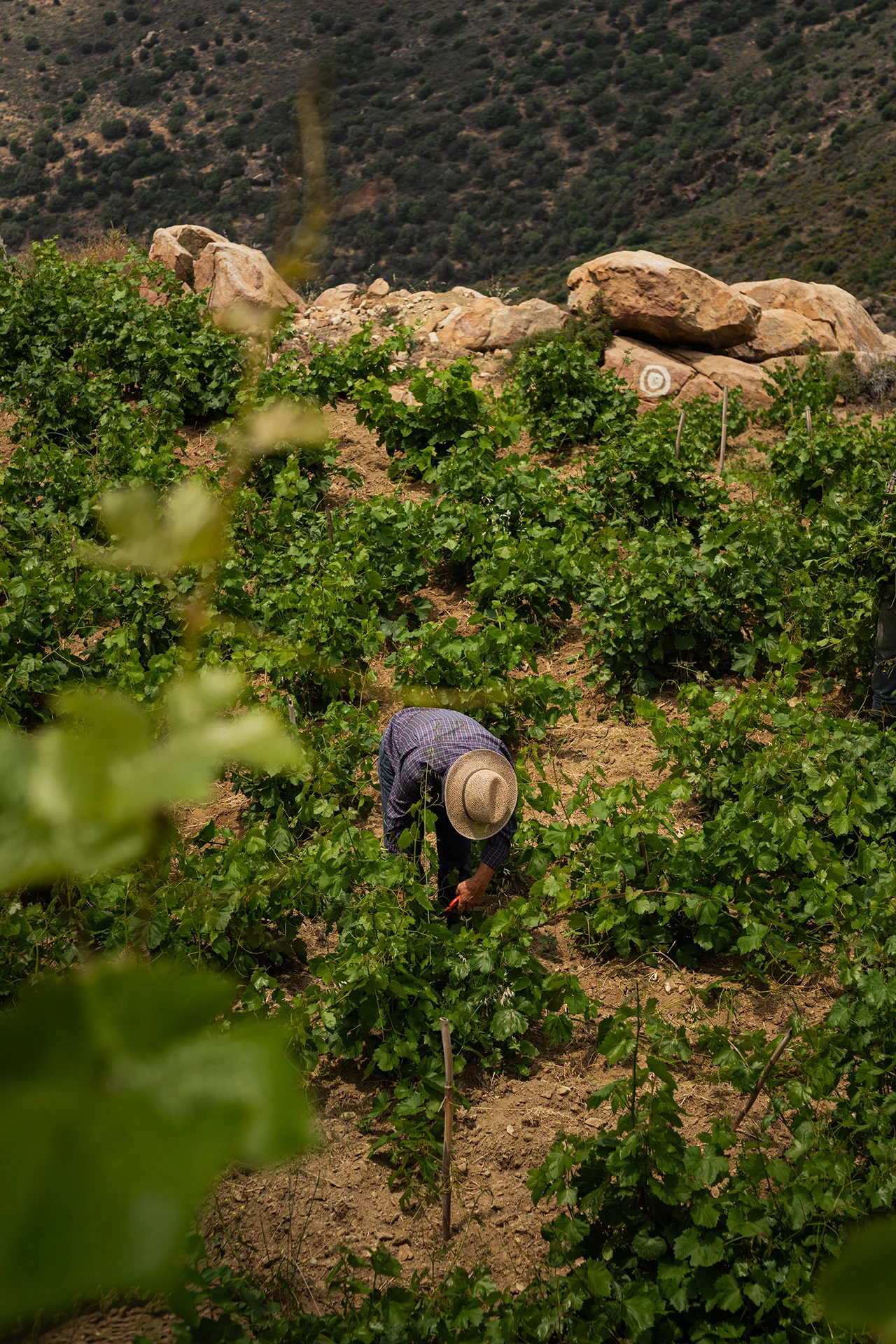
The Estate’s vineyards extend from the coastal slopes of the wild Abram cape to the steep slopes of Mount Koronos (999 m — the second highest mountain in the Cyclades after Mount Zas), reaching altitudes of 700–800 meters, with gradients exceeding 70% in certain locations.
The old pre-phylloxera vineyard, planted with Assyrtiko, Aidani, Potamisi, Fokiano, Monemvasia, and Mandilaria, is not continuous but divided into smaller plots at different elevations, vineyard sites, and terroirs, forming a mosaic of varieties, terroirs, and expressions.
All vineyard sites face north to northwest. The wisdom of earlier vine growers anticipated the need for proper ventilation, natural cooling, and disease protection.
Ninety percent of the vineyards are dry-farmed, all planted on old terraces ensuring excellent drainage and protection against erosion. Soil composition varies by area: limestone and schist dominate the subsoil, while the top layer consists of humus-rich, sandy-clay, or loamy soils.
Production is exceptional with low yields per hectare due to the great age of the vines, extending so far back that precise dating is impossible. Scientific estimates suggest around 200 years, while local elders and tradition speak of more than three centuries of life.
The cultivation is organic, with great respect for the land, following biodynamic practices and the principles of heroic winemaking that the family has passed down from generation to generation. The four Korres siblings today represent the fifth generation of the family’s winemakers and proudly maintain this tradition.
Like all the estate’s cultivations and products, the vineyards and wines are certified organic by the DIO organization. The harvest, as well as all work on the estate, is carried out exclusively by hand, as the particularly steep terrain of the area does not allow for any other approach. Small mechanical tools are used only where and when deemed absolutely necessary.
In most of the estate’s vineyards, after careful study, a few hives from the beehives that the estate has always maintained were installed. These precious insects act as silent guardians of the ecosystem. Through the pollination of wildflowers and native plants, the bees enhance biodiversity, contribute to ecological balance, to the resilience and vitality of the soil, while simultaneously enriching the terroir, creating a natural connection and continuity between the final product and the terroir.
Their presence is an indicator of the good health of the vineyard ecosystem, warning of potential environmental anomalies or threats, as bees are the most sensitive bioindicators, and their survival in an ecosystem signifies that everything is functioning smoothly and no imbalances exist.
Today, the family is organizing the expansion of the vineyards by creating a new, unified 80-stremma vineyard on a slope at an altitude of 300–400 meters with a northwestern orientation, directly opposite the winery and wine-tourism resort under construction, reviving native Cycladic grape varieties that constitute the natural continuation of the region’s winemaking tradition and history.

